
Building liberal compute
American AI companies won’t move to Europe. But we can work to have them deploy compute on liberal shores.

Compute—the physical infrastructure required to run AI—will soon become a central lever of economic and strategic power. Today, compute is extremely unevenly distributed: 74 percent of it sits in the United States, 14 percent in China, and only 6 percent in Europe. This won’t change anytime soon, as new compute is mostly constructed outside of Europe.
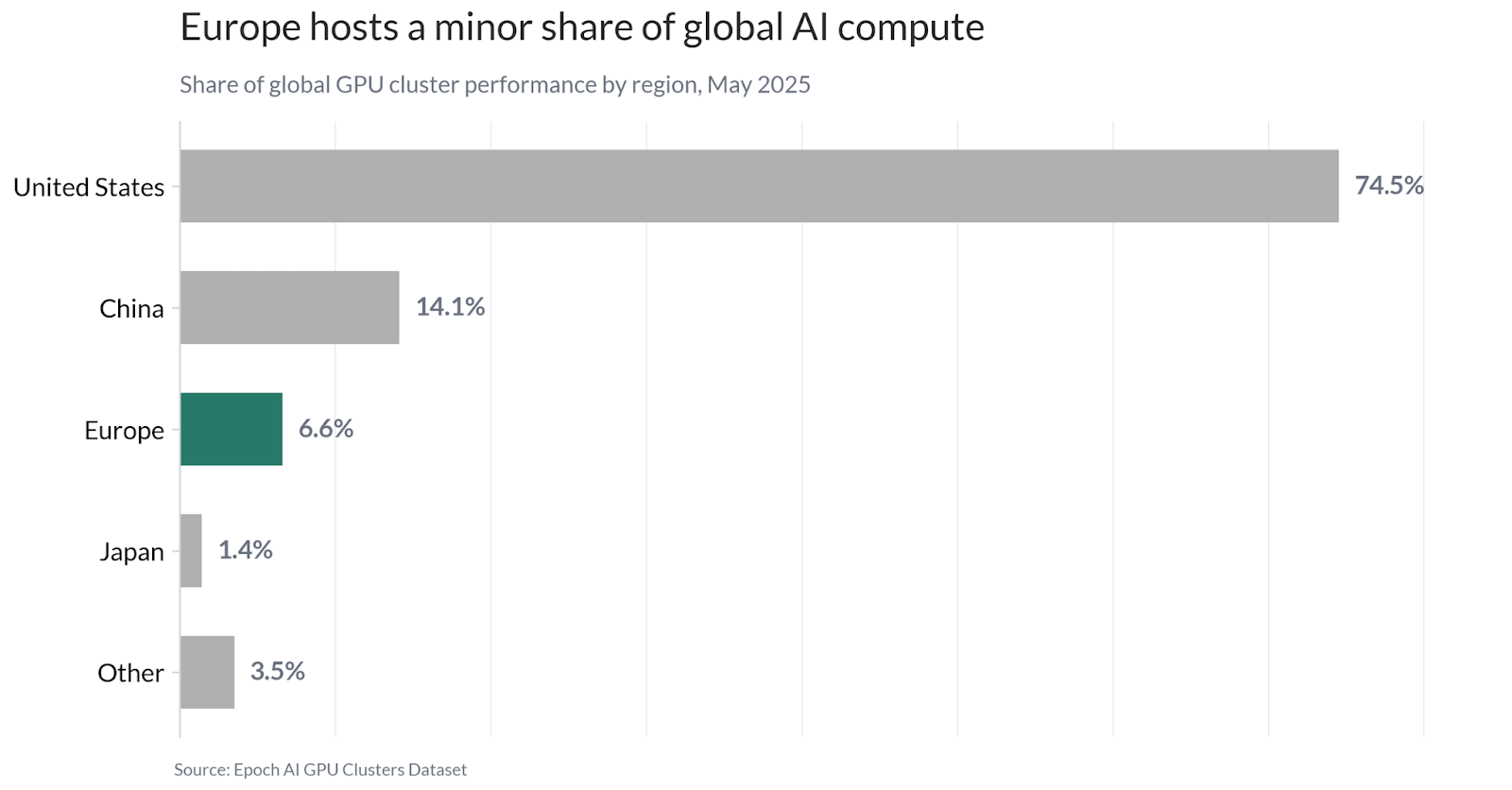
Europe’s lack of compute is concerning. The US is receiving investments, growth, and jobs through its AI infrastructure build-out, while few such build-outs happen in Europe. As a result, European companies and governments also miss out on the tacit knowledge gained by building large-scale datacenters. Compute itself has both economic and strategic importance: economies and militaries that run on top of frontier AI systems will be far more efficient, making restrictions on frontier AI system use devastating. But such restrictions might become harder once several companies host AI infrastructure in European nations.
Hence, Europe should prioritize attracting compute build-outs. Some governments and parts of the European Commission have begun trying to build local data centers, but many of these efforts are much too statist. The European Union frequently talks about funding AI infrastructure, but a multilateral, consensus-based institution is not set up to orchestrate the construction of massive infrastructure projects: You need to decide on one site, which creates competition among member states, and the amount of capital required creates financial risk that governments are unlikely to take on. Most importantly, there is no European frontier lab acting as the final customer: the Commission’s “AI Gigafactories” are not moving forward because companies like Siemens and SAP simply do not require that much compute.
But there are entities out there who share classic European values, and who need compute: American AI companies.
Convincing European governments to host American companies is not particularly easy. But European nations need frontier AI systems. The more components underlying those systems are based in Europe, the better. And American companies might themselves have an interest in hosting some of their compute outside the US. Their own government is not following basic tenets of liberalism, such as respecting Anthropic’s private property. Building compute in the UAE is looking more precarious, now that Iranian drones hit AWS data centers. In comparison to its competitors, Europe is looking better each passing day.

Liberal compute
After the US executive branch crackdown on Anthropic, there has been talk of getting Anthropic to move to Europe. I believe this is very unlikely: Right now, Anthropic would be leaving its entire infrastructure behind, which the USG could possibly seize. Most importantly, it’s politically untenable, both for Anthropic, and for European governments1.
But a more pragmatic long-term plan would be to get AI companies to build more of their compute in Europe. Given the few good AI policy options European governments are faced with, this is one of the highest upside actions they can take.
Ideally we’d have a European company with demand for such compute. Alas, that’s not the world we’re in.
Instead we could either choose to remain stuck in a situation where American companies are running models on clusters based in the US, or one in which more AI clusters are constructed in European nations. As a European, the latter world still seems far preferable to me. Though I think relations between the US and Europe have a chance of becoming calmer, and the US might become more liberal again, it remains possible that the US government tries to cut off European access, especially once the power of AI systems becomes obvious to all. This will be harder if European economies are working with several AI companies at the same time, all of whom have their inference infrastructure hosted in Europe.
There is a further, much more speculative point here. The type of government that would make the US try to cut off Europe might also be staffed by people adversarial toward some companies like Anthropic. In such a world, AI will be highly advanced, so those companies themselves will be powerful and might resist government coercion, especially when this government is not aligned with their priorities. This scenario is unlikely, but if it were to occur, giving companies an escape valve where they retain power by using European compute would be highly valuable. For this, companies will require having such compute available in the first place.
European governments are currently not considering such outcomes. Unlike the leaders of some Gulf states, few European heads of state are cognizant of the massive impacts of AI. But we still need to make plans for the moment they become aware.
The perks of Europe
At first glance, building infrastructure in Europe is difficult—its environmental laws are strict and its energy prices ($90/MWh) are often twice as high as in the US ($48/MWh). But some of these problems are smaller than they appear at first glance.
In Germany, construction has been getting faster: Germany’s first LNG terminal was planned and constructed in 10 months. Tesla’s first European factory in Brandenburg went from announcement to construction in 2.5 years. Unlike the US or the UK, the country is further simplifying its permitting rules, labeling a lot of infrastructure as being in the “supreme public interest”.
In Norway, construction of a large data center is underway: OpenAI is building Stargate Norway, with a final capacity of 520 MW. This is in part enabled by hydropower plants owned by Nordkraft, which can offer low energy prices because it sits in an area with limited demand and poor transmission capacity.
Now, one should stay clear-eyed. Stargate Norway is nowhere near the scale of projects abroad. Meta’s Hyperion is planned as a 2GW campus, with a final capacity of 5GW. Stargate UAE’s final size will be 5GW. Training models in Europe is made difficult by strict data laws and copyright protections (which make demand-side AI measures by the Commission ineffectual, given that their supply-side restrictions negate any stimulus and innovation).
But attracting compute to Europe remains a great strategic option. Unlike many other measures the Commission is pursuing, easing American compute buildouts works along the desire of markets, not against them. While training models in Europe is difficult, inference demand will only increase. As of mid-2025, OpenAI uses half of its compute for inference, and this share will likely rise further. And while companies currently serve European AI demand from the US (because latency doesn’t matter with slow-running frontier models), this might not be tenable for long, as interactions with AI become more seamless (e.g., when using voice interaction).
Laying the ground work
There is still a lot of intellectual work to be done on what a realistic pathway to more European compute could look like. But several actions look pretty good already.
First, national capitals need to take AI seriously as fast as possible. Right now, many of them simply lack the knowledge required to understand what is coming. When doing such advocacy work, one should focus on countries that fulfill criteria required for quickly building large data centers: fast permitting, local taxation that minimizes NIMBYism, government structures that allow rapid action, and pragmatic attitudes toward American AI companies. That rules out some countries2, but leaves a number of viable candidates.
We also need to be more forthright about why existing sovereignty initiatives can’t be the answer to being behind—though when pointing this out, we should ideally point to constructive alternatives. The government cannot coordinate the buildout of compute infrastructure, but large companies that promise to spend multi-billion foreign investment might have more success. Not all companies involved in such build-outs must be foreign: there are hyperscalers with European roots, such as nscale or Nebius.
Finally, we need more work pushing the European Commission toward a supply-side approach to AI. Instead of regulating the use of AI (see previous piece), slowing down Germany’s pivot to gas power plants, mandating energy-efficient data centers, and hampering frontier AI training, they could help by identifying the largest regulatory bottlenecks to AI development and deployment, and unblocking those.
Giving European nations a stake in the future of artificial intelligence is crucial. We can get closer to this world by moving more data centers to Europe. There is still vast strategic complexity for how to best achieve this, but thinking about which actions to take sooner rather than later is one of our better bets.
Thanks to Dominik Hermle for reviewing a draft of this post.
More flexible, pragmatic governments could offer reduced corporate tax or income tax for American AI companies that open their offices in their country. There is a reason why Switzerland has Google’s largest engineering headquarters outside of the US—the country has very favorable business conditions!
Including, sadly, Switzerland, which has little open space for large build-outs but fulfills a number of other criteria.
Another case that might convince more people: if we want to deploy AI in logistics and manufacturing at scale, we'll need exceptional latency for embodied agents to work. They will make huge amounts of inference calls to function, most of our future compute needs original there, not humans calling AIs, but AIs calling tools and other AIs.
If we can't supply the compute in Europe, China alone will remain the manufacturing backend, bc they have the energy, space and engineering prowess.
Unfortunately, the investors I've talked to seem to think that even if you wanna buy compute, there isn't currently enough to buy up. So we'll have to also ramp up domestic fabs, potentially?